Article type: Analysis
Abstract. The MORE/LESS pair specifies a destination and a diagnosis: MORE proposes an objective that increases the capacity of the whole living system within floors; LESS characterises the incumbent trajectory as the successful pursuit of a different objective, in which the effective shadow price of unpriced life-capacity is approximately zero. Neither paper explains how one objective replaces another. This paper fills that gap. We endogenise the shadow price θ as a state variable, formalise the switching operator S — the counterpart to LESS’s trajectory operator T_L — as a coalition game in which beneficiaries of the incumbent objective select the rules, and derive eight falsifiable switching propositions: ratchet asymmetry, measurement-before-internalisation, standing before pricing, windows rather than gradients, counter-coalition feasibility, escape-cost conditions, verification-decay reversal, and the adoption condition for the MORE objective. We test the mechanisms in a reproducible in-silico coalition model and score ten historical θ-transitions — from the Montreal Protocol to the EU Omnibus rollback — against declared rules. The carbon-pricing record (coverage rising from ~5% of emissions in 2005 to ~29% in 2025–26) provides the first measured θ-trajectory. It also formalises cared-set expansion — the process by which “more for myself and the lives I care about” becomes “more for all life.” IS is analytic: it describes how objectives switch, never asserts that they should. Its claim to originality is formal specificity and falsifiability — a measurable object of transition, stated mechanisms, and coded cases — rather than influence.
Keywords: sustainability transitions, revealed objective, shadow price, policy feedback, coalition formation, ratchet effects, is–ought gap
A diagnosis without a transition theory is counsel; a proposal without one is utopian. LESS shows that the incumbent trajectory is consistent with a revealed objective Φ in which unpriced life-capacity carries a shadow price θ≈0. MORE shows what follows if the Commitment “all action should be for more for all life” is adopted: a life-capacity objective W, floors, participants, verification, and a propagation capacity p(t) across worlds. Between them sits the question neither answers: how does θ move? Under what conditions does the effective shadow price of life-capacity rise from ≈0 toward the level a life-capacity objective requires — and under what conditions does it fall back?
This paper answers that question as IS — the copula between is and ought. LESS is descriptive (what objective the system appears to pursue). MORE is normative-constructive (what objective the Commitment implies). IS is analytic: it models the transition between objectives as a political-economic process with state variables, mechanisms, and falsifiable signatures. It takes no position on whether θ should rise; it specifies when, how, and with what durability it does.
The framing is deliberately continuous with the trilogy. LESS defines the trajectory operator T_L, which moves the capacity vector C(t) forward given an objective. IS defines the switching operator S, which moves the objective — equivalently, moves θ — given a coalition landscape. The two operators compose: a transition in θ changes T_L’s argument; the resulting trajectory changes the stakes over which coalitions fight. The trilogy thus becomes a dynamical system: Φ and W are regimes, T_L and T_W are intra-regime dynamics, and S is the inter-regime operator whose study is this paper.
Three claims structure the paper:
Section 2 positions IS against the transition-science literature and states the surpass benchmark honestly. Section 3 gives the plain-language version. Section 4 formalises the model. Section 5 states the ten transition principles T1–T10. Section 6 states the eight switching propositions S1–S8 with falsification conditions. Section 7 codes the case library. Section 8 reports the in-silico results. Section 9 examines the first measured θ-trajectory — carbon pricing. Section 10 draws implications for MORE’s implementation sequence. Section 11 answers objections. Section 12 states limitations and the research agenda.
Transition studies is a mature field. IS does not claim the topic is new; it claims a specific formal object and evidentiary standard that existing frameworks lack. Table 1 scores the predecessors on five criteria: a measurable object of transition, formal switching dynamics, falsifiable propositions, coded historical cases, and commensurability with a constructive alternative.
Table 1. Predecessor frameworks scored against IS’s criteria
| Framework | Measurable object | Formal dynamics | Falsifiable propositions | Coded cases | Commensurable w/ W |
|---|---|---|---|---|---|
| Multi-Level Perspective (Geels 2002, 2011) | ◐ regime described qualitatively | ◐ niche/regime/landscape heuristics | ○ few stated tests | ● extensive | ○ |
| Technological Innovation Systems (Bergek et al. 2008) | ○ functions assessed | ○ diagnostic lists | ○ | ● | ○ |
| Strategic Niche Management | ○ niche experiments | ○ shielding/empowerment | ○ | ◐ | ○ |
| Policy feedback / increasing returns (Pierson 2000) | ○ | ○ path dependence formalised in parts | ○ | ◐ | ○ |
| Acemoglu–Robinson institutions (Acemoglu and Robinson 2006) | ○ elite/mass conflict | ● formal model | ● within model | ◐ | ○ |
| Kingdon agenda windows (Kingdon 2011) | ○ | ○ | ○ | ● | ○ |
| Positive tipping points (Lenton et al. 2025) | ● technology adoption | ◐ cascade models | ◐ | ● | ○ |
| Aklin–Mildenberger distributive conflict (Aklin and Mildenberger 2020) | ○ | ○ | ○ | ◐ | ○ |
| Battle-settlement events (Patterson and Paterson 2026; Patterson et al. 2025) | ○ | ○ | ○ | ● | ○ |
| LESS (companion) | ● θ≈0 revealed objective | ● T_L on shared state space | ● L1–L7 | ● panel | ● |
| MORE (companion) | ● W objective + floors | ● capacity dynamics | ● P1–P10 | ◐ in-silico | — |
| IS (this paper) | ● θ(t) endogenised | ● switching operator S | ● S1–S8 | ● coded library | ● shared C(t) |
Reading of the table. IS’s surpass claim is narrow and checkable. Geels’ MLP remains the best general account of how socio-technical regimes change — and IS inherits its core insight that transitions are multi-level alignment problems, not single-lever policy problems. But MLP’s object is the regime: a configuration of technologies, actors, and institutions. IS’s object is the objective: the weighting θ that determines which configurations are selected for. These are different levels — a regime can change while θ stays near zero (solar adoption under continued extraction elsewhere is exactly this), and θ can rise without any single technology tipping (Montreal changed the objective for one stock while leaving others). Positive tipping-point work (Lenton et al. 2025) makes the complementary error in the opposite direction: it identifies conditions under which technologies tip, and IS’s framework explains why technology tipping and objective switching are separable — cost collapse lowers S’s switching cost (our S6) but does not itself raise θ.
The honest claim: IS is designed to surpass its predecessors on formal specificity and falsifiability — a measurable object (θ), a stated operator (S), propositions with failure conditions (S1–S8), and a coded case library under declared rules — not on influence, which no working paper can claim. The gap is not idiosyncratic to IS’s reading: a 2026 systematic comparison of eight transition frameworks finds persistent blind spots in power, justice, and spatial scale (Nicolas-Artero and Dell’Angelo 2026). Where predecessors offer frameworks to apply, IS offers a model to break.
Two intellectual debts must be acknowledged. Acemoglu and Robinson (Acemoglu and Robinson 2006) supply the mechanism IS formalises: institutions persist because beneficiaries select the rules, and change when a counter-elite’s gains exceed organisation costs — IS’s switching condition is their commitment-problem logic applied to objective weights rather than property rights. Kingdon (Kingdon 2011) supplies the window mechanism IS formalises as exogenous variation in switching cost (S4). Schelling’s threshold model (Schelling 1971) supplies the microfoundation for coalition tipping: individual switching decisions depend on the expected decisions of others, producing the critical-mass dynamics our simulation reproduces.
LESS says the system behaves as if life-capacity depreciation is priced at θ≈0. The carbon-pricing record shows the price is not fixed — it has been rising, unevenly, in steps. The World Bank’s State and Trends of Carbon Pricing series documents direct carbon-pricing instruments covering roughly 5% of global greenhouse-gas emissions in 2005 and approximately 29% in 2025–26, with 87 implemented policies and over US$107 billion in public revenue in 2025 (World Bank 2026). That is a θ-trajectory for at least one depreciation channel: coverage quintupled in two decades, then jumped again when China’s ETS expansion added coverage in a single step.
IS asks what governs such movements. The answer has five parts:
Measurement first. You cannot price what you cannot see. Every durable θ-increase in the case library is preceded by a measurement system — INPE satellites before Brazil’s PPCDAm enforcement, continuous emissions monitoring before US SO₂ trading, atmospheric observations before the Montreal Protocol. Depreciation that is invisible cannot enter anyone’s objective, because it cannot enter their information set.
Standing before pricing. Where incumbents are organised — fisheries, tobacco, fossil incumbents — giving affected life or future persons legal standing changes the payoff matrix before any price does. The Whanganui River’s legal personhood (Parliament of New Zealand 2017) and Ecuador’s constitutional rights of nature (Asamblea Constituyente de la República del Ecuador 2008) are attempts to move θ through standing rather than pricing.
Coalitions, not preferences. θ rises when actors who gain under the higher price can organise — renewable-energy firms as created beneficiaries of carbon pricing (Meckling et al. 2015) — and falls when incumbents who lose under it can reorganise. The binding constraint is distributive: who wins and loses under θ′, and whether the winners can pay the costs of switching (Aklin and Mildenberger 2020).
Windows, not gradients. Switches cluster at moments when organisational costs collapse — succession, crisis, scandal, technological surprise — not at moments when the underlying damage is worst. Brazil’s deforestation control tightened under one administration, reversed under the next, and re-tightened under a third (Instituto Nacional de Pesquisas Espaciais 2026); the EU’s sustainability-reporting rules were rolled back by a single Omnibus directive in 2026 after partial internalisation had begun (European Parliament and Council of the European Union 2026). Damage accumulates continuously; θ moves in steps.
Verification is the ratchet. Once θ rises, it stays up only while the measurement-and-verification apparatus that made the rise possible survives. Where verification is dismantled — monitoring budgets cut, reporting rules narrowed — θ decays back toward the incumbent equilibrium. The Omnibus rollback is live evidence: reporting scope was cut ~90% for sustainability disclosures and ~70% for due-diligence duties not because damages rose, but because the verification infrastructure that sustained the higher θ was itself dismantled.
The cared circle makes this precise. LESS’s Φ is not universal self-interest; it is circle-limited — “more for myself and the lives I care about.” The effective shadow price θ is distance-dependent: near zero for depreciation borne by life outside the cared set, possibly substantial within it. MORE’s Commitment is the same objective with the circle expanded to all life. IS therefore models not only price movements but cared-set expansion — the historical process by which the set of lives counted in the objective grows (abolition, citizenship, animal welfare, ecosystem standing). Rights-of-nature cases and tobacco control are circle-expansion transitions in exactly this sense: they extend who counts before they change what anything costs.
The result is a transition theory with a measurable object (θ), a stated mechanism (coalition switching under cost asymmetries), and an ordering principle for action: measurement → standing → verification → pricing — the reverse of the usual policy sequence, and the reason MORE’s implementation guidance must begin with visibility, not persuasion.
We work on the shared state space of the trilogy. The capacity vector is
with world-indexing and propagation capacity as in MORE and LESS. IS adds one scalar state variable to the objective side:
the effective shadow price of unpriced life-capacity depreciation — the weight with which decisions actually internalise the depreciation term in the revealed objective
LESS is the special case θ≈0; MORE’s objective W corresponds to θ at the level implied by its floors and weights (formally, W is not a single θ but a vector of weights — IS treats θ as the scalar summary of the internalisation margin, the dimension along which LESS and MORE differ most sharply). The switching problem is to describe the dynamics of θ(t).
Two auxiliary state variables matter:
A third variable is the cared set living system: the collection of lives and capacities whose welfare enters actors’ payoffs. LESS’s Φ corresponds to a small, parochial (self, kin, ingroup); MORE’s W to = all life. The effective shadow price is distance-dependent: for depreciation borne by life in actor ’s decisions is near zero when and can be substantial when . The scalar θ(t) of §4.1 is the cared-set-weighted aggregate. Cared-set expansion — growing to include ecosystems, future persons, distant others — is therefore a distinct transition type: it changes the objective without changing any price, and it is the mechanism by which “more for myself and the lives I care about” becomes “more for all life.”
LESS’s trajectory operator advances given the objective. IS’s switching operator advances θ given the coalition landscape:
where is the coalition structure — the partition of actors into those gaining and losing under each candidate θ′ — and indexes window events that temporarily reduce organisational costs.
In discrete time the operator reduces to a gated update rule:
— the full piecewise form with decay and diffusion terms is in the
working draft (is-paper.md §4.2).
The core switching condition is distributive. Let denote actor ’s gain from moving θ to θ′. A coalition favouring θ′ forms and succeeds when
where is the coalition’s organisational capacity (mass × coordination) and the right side combines organisation costs with the direct costs of changing rules. Three asymmetries make this non-trivial:
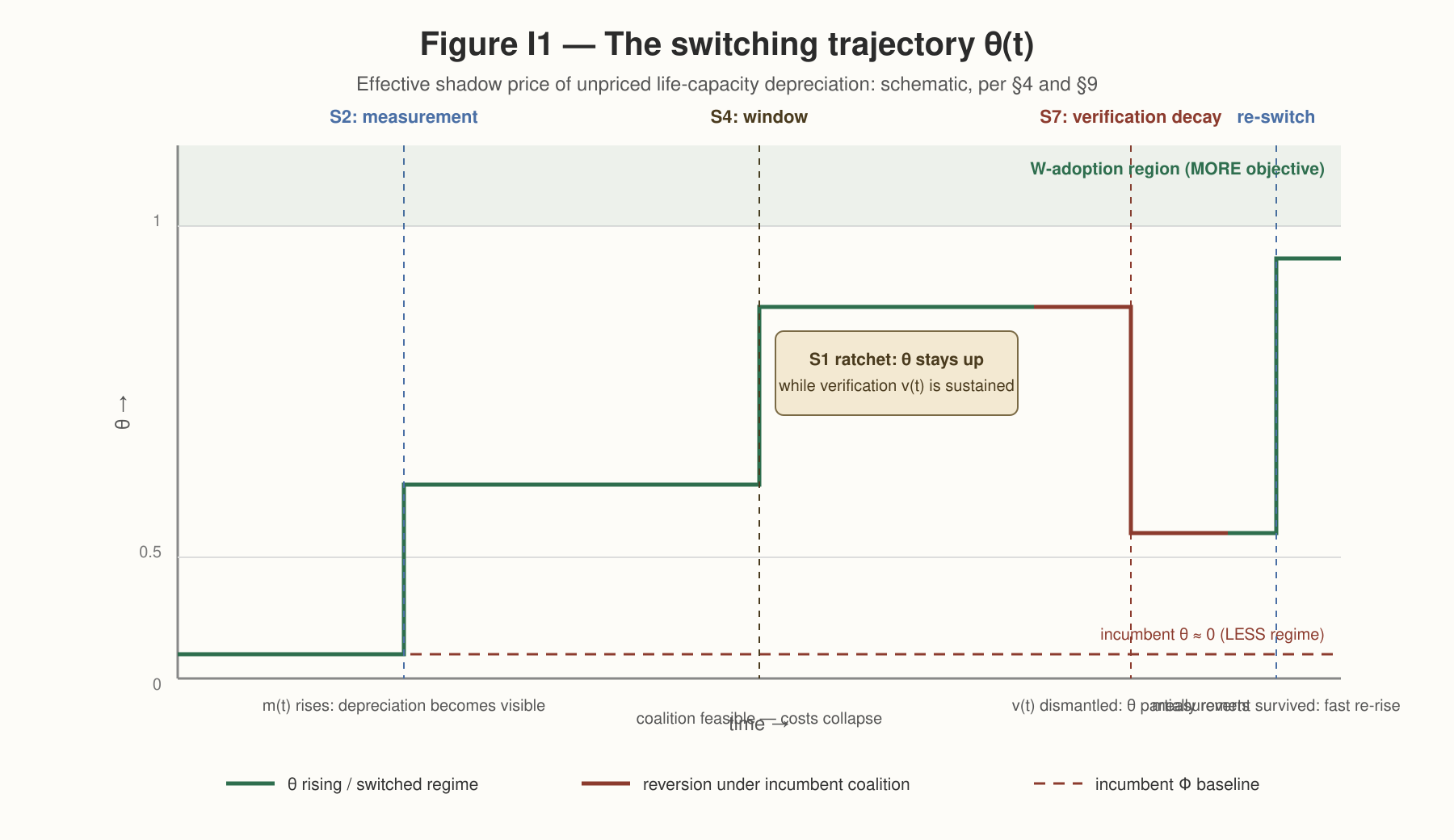
Figure I1. Schematic θ(t) trajectory. θ stays near zero under Φ until measurement makes depreciation visible (S2); a window collapses organisational costs and a feasible counter-coalition switches the regime (S4, S5); the high-θ regime persists only while verification is sustained (S1 ratchet); verification decay permits partial reversion (S7); surviving measurement enables fast re-switching — the Brazil double-arc and EU Omnibus signatures.
Following Schelling (Schelling 1971), individual participation depends on expected participation: each actor joins the counter-coalition only if enough others do. This yields a critical-mass condition — a threshold share of actors whose gains under θ′ exceed their share of organisation costs — below which no switch occurs regardless of elapsed time, and above which switching is rapid. The in-silico model (§8) reproduces this threshold structure: switch probability is near-zero below q* and near-one above it.
MORE’s objective W is not a single θ but a weighting across capacity dimensions with floors. IS’s S8 proposition states the adoption condition: W-adoption is feasible iff there exists a coalition whose gains under W — including the created-beneficiary effects of verified contribution, the insurance value of floors, and the option value of p(t) — exceed organisation plus switching costs against the incumbent coalition. This is deliberately weaker than “W is better”: it is a statement about who can make it happen, which is the only kind of statement a transition theory can honestly make.
Combining the pieces, θ(t) follows a characteristic saw-tooth-with-ratchet path (Figure I1). In the incumbent regime, θ sits near zero because (i) depreciation is unmeasured or unverified in most channels (low m, low v), and (ii) the incumbent coalition’s organisation cost is sunk. Three events can move θ:
Between events, θ drifts: upward pressure comes from diffusion (jurisdictions copying instruments — the carbon-pricing series’ slow climb) and from declining substitute costs (S6); downward pressure comes from incumbent reorganisation and verification decay. The net trajectory is not monotone — the carbon-pricing record shows rises, plateaus, and the Omnibus-class reversals simultaneously. IS’s claim is that this irregular path is structured: every movement traces to a coalition feasibility event under the cost asymmetries of §4.2.
LESS §10 leaves three problems that are IS’s charter: (b) estimate the trajectory operator T_L and compare eras — IS reframes this as estimating θ(t) and S across eras; (c) identify conditions under which θ>0 historically emerged — the case library is the first coded answer; (d) formalise the objective-switching problem — §4 is that formalisation. IS does not solve LESS’s estimation problems; it relocates them onto the objective side, where they become questions about coalitions and verification rather than capacity trajectories.
The principles mirror the family’s design-principle structure. Each is stated as a design rule for whoever would move θ, with the mechanism it relies on.
T1. Measure before you price. No durable θ-increase survives without visibility into the depreciation channel. Build measurement first; it is the cheapest and most durable component of any transition.
T2. Give standing before demanding sacrifice. Where the harmed party is diffuse or future — ecosystems, future persons, animals — standing or proxy representation changes payoffs before prices do. Legal personhood is a θ-technology; it works precisely because it enlarges the cared set — it makes the harmed entity count before it makes its harm costly.
T3. Build the beneficiary coalition. Transitions need actors who gain under θ′, not only actors who suffer under θ. Carbon pricing succeeded where it created winners — efficiency rents, clean-tech markets — and stalled where it only imposed costs (Meckling et al. 2015).
T4. Exploit windows; do not wait for gradients. The damage gradient is nearly always present; the organisational-cost gradient is what matters. Prepare coalitions in advance so they can fire at windows — succession, crisis, scandal, technological surprise.
T5. Verification is the ratchet. A θ-increase is only as durable as the apparatus that measures and enforces it. Fund verification as permanently as the policy it verifies; assume it will be attacked.
T6. Escapes beat exhortations. Where substitutes exist — CFC alternatives, solar cost curves — switching costs fall and θ can rise through markets rather than mandates. Engineer substitutes first where possible.
T7. Expect reversal; design for re-switching. Every historical θ-increase in the library faces counter-coalition reorganisation. The question is not whether reversal is attempted but whether verification survives it. Preserve measurement through the reversal; re-switching then costs a fraction of the original switch.
T8. Sequence across channels. θ is channel-specific: emissions pricing rose while biodiversity, ocean, and frontier-capacity θ stayed near zero. Transition capacity is scarce; allocate it to channels where measurement is cheapest and substitutes exist first — predictability orders the work.
T9. Couple the levels. Landscape pressures (crisis, geopolitics, technology shocks) open windows; regime-level coalitions exploit them; niche-level experiments provide the substitutes and demonstrations that lower switching costs. Transitions fail when any level is missing — MLP’s core insight, retained.
T10. IS is not MORE. IS describes how objectives move; it does not assert they should. A reader who rejects the Commitment can still use IS to analyse any objective transition — including transitions away from life-capacity weights. The theory is symmetric in its object and asymmetric only in its honesty about mechanisms.
Each proposition states a mechanism, a prediction, and a falsification condition — the family’s evidentiary discipline.
S1 (Ratchet asymmetry). Claim: raising θ is harder than lowering it, but a raised θ persists while verification survives. Falsification: historical episodes where θ fell without verification decay, or rose without measurement infrastructure. Status: supported in-silico (§8); case-consistent (Brazil, EU Omnibus); not yet econometrically estimated.
S2 (Measurement precedes internalisation). Claim: no durable θ>0 emerges in a channel without prior measurement of that channel’s depreciation. Falsification: a documented case where pricing or internalisation became durable while the depreciation remained unmeasured. Status: case-consistent across all ten library cases; in-silico gate is absolute (§8).
S3 (Standing precedes pricing where incumbents are organised). Claim: where losers under θ′ are organised incumbents (fisheries, tobacco, fossil), legal standing for the harmed party changes the payoff matrix before prices do — standing works by enlarging the cared set, making the harmed entity count before its harm costs anything. Falsification: organised-incumbent cases where pricing succeeded without any standing/representation change. Status: case-consistent (rights of nature, tobacco, cod); the counterfactual is untestable directly — flagged.
S4 (Windows, not gradients). Claim: θ-movements cluster at organisational-cost collapses (succession, crisis, scandal, technology surprise), not at damage maxima. Falsification: θ-transitions occurring at predicted non-window times at rates indistinguishable from windows. Status: case-consistent (Lula succession, Omnibus coalition, China ETS expansion); in-silico windows triple switch probability at fixed coalition size (§8).
S5 (Counter-coalition feasibility). Claim: a switch requires a coalition whose θ′-gains exceed organisation plus switching costs — feasibility is a threshold property of coalition structure, not a gradient of damage. Falsification: switches occurring below the modelled feasibility threshold, or persistent non-switches above it with no compensating mechanism. Status: in-silico threshold reproduced sharply (§8); case-consistent.
S6 (Escape-cost condition). Claim: transition speed and ceiling rise where substitutes for the incumbent practice exist; where escape costs are high, θ stays low even under measurement. Falsification: rapid θ-transitions in high-escape-cost channels without substitute emergence. Status: case-consistent (CFC substitutes enabled Montreal; solar cost collapse precedes any energy θ-shift — GTPR 2025); in-silico monotone (§8).
S7 (Verification decay reverses transitions). Claim: θ reverts toward incumbent levels when the verification apparatus is captured or dismantled, at a rate proportional to decay and inversely proportional to remaining coalition strength. Falsification: durable θ>0 regimes surviving complete verification dismantling, or instant reversals while verification remains intact. Status: live case evidence (EU Omnibus 2026); Brazil double-arc consistent; in-silico reversal timing scales with decay rate (§8).
S8 (W-adoption condition). Claim: MORE’s W is adoptable iff a coalition exists whose gains under W — including created-beneficiary, insurance, and option-value terms — exceed organisation plus switching costs. Falsification: a documented W-consistent transition achieved without such a coalition, or a feasible coalition that persistently fails to switch. Status: the proposition IS was built to state; first-pass in-silico consistent; awaits the first real test.
Ten θ-transitions coded under declared rules
(research/data/transition-cases.csv; register and licences
in research/data/PROVENANCE.md). Scoring: which mechanisms
fired (S-codes), the sequence, and whether the ratchet held or reverted.
“θ-channel” names the depreciation dimension moved; none of the cases
moved θ economy-wide — that is itself a finding (T8).
Table 2. Coded case library
| Case | θ-channel | Mechanisms fired | Ratchet verdict |
|---|---|---|---|
| Montreal Protocol (1985–) | ozone-depleting substances | S2 (satellite/obs → science), S4 (scientific consensus window), S6 (CFC substitutes) | Held; compliance durable; HFC/CFC climate externality migrated the problem rather than eliminating it; recovery trajectory confirmed in the 2026 WMO/UNEP assessment (World Meteorological Organization and United Nations Environment Programme 2026; World Meteorological Organization 2023) |
| US SO₂ cap-and-trade (1990–) | acid rain / SO₂ | S2 (CAMPD continuous monitoring), S3 (standing via Clean Air Act), S5 (allowance-trading created market constituency) | Held; ~90% SO₂ reduction documented by EPA (United States Environmental Protection Agency 2025a) |
| Lead phaseout (1970s–96) | neurotoxin exposure | S2 (blood-lead surveillance), S4 (succession of regulatory action), S5 (public-health coalition) | Held; EPA documents completed phaseout (United States Environmental Protection Agency 2025b) |
| Newfoundland cod moratorium (1992) | fish stock collapse | S4 (crisis window) — too late: collapse preceded action | Failed prevention; the “window arrived after θ would have mattered” case (Myers et al. 1997) |
| Brazil Amazon (2004–26) | deforestation | S2 (INPE PRODES/DETER), S4 (administration changes ×3), S7 (Bolsonaro-era verification decay → reversal), re-switch under Lula | Double arc: rise → partial reversal → re-rise; 2026 PRODES estimate −41.8% y/y, historic low (Instituto Nacional de Pesquisas Espaciais 2026) — measurement survived, enabling re-switch |
| EU ETS + Omnibus (2005–26) | carbon pricing (partial) | S3/S5 (market creation), S7 (live: Directive (EU) 2026/470 cut CSRD scope ~90%, CSDDD ~70% via far-right + industrial coalition) | Partial internalisation reversing at both layers — verification (Omnibus) and price (Nov-2026 free-allocation deal, ~121M allowances 2026–30 (Council of the European Union 2026)) — the S7 signature observed in real time (European Parliament and Council of the European Union 2026) |
| Global carbon pricing (2005–26) | carbon (coverage) | S4 (China ETS expansion 2021; 2026 launch wave: Japan mandatory ETS + India + Viet Nam (International Carbon Action Partnership 2026; International Institute for Sustainable Development 2026)), S5 (diffusion + revenue constituencies) | Rising but shallow: ~30% coverage ≠ θ economy-wide; prices vary ~100×; record ETS revenue ~$80B (2025) (World Bank 2026; International Carbon Action Partnership 2026) |
| Rights of nature (2008–) | ecosystem standing | S3 (Te Awa Tupua 2017 legal personhood (Parliament of New Zealand 2017); Ecuador 2008 constitution arts. 71–74 (Asamblea Constituyente de la República del Ecuador 2008)) | Standing established; enforcement θ still contested — standing ≠ price |
| Tobacco control (1960s–) | public-health externality | S2 (epidemiology), S4/S5 (surgeon-general reports → counter-coalition vs industry), litigation windows | Held in high-income states; WHO documents continued global burden and industry adaptation (World Health Organization 2023) |
| Solar/wind tipping (2010–25) | energy substitution | S6 (cost collapse: GTPR 2025 identifies global positive tipping in solar/wind, leading-market EV/battery/heat pumps (Lenton et al. 2025)) | Instructive partial: technology tipped while economy-wide θ stayed low — S6 lowers switching cost without itself raising θ |
Cross-case regularities. (i) Every durable θ-increase has a measurement ancestor; the cod case shows what happens without early measurement — the window arrives after the stock is gone. (ii) No case achieved economy-wide θ; transitions are channel-specific, consistent with θ being a vector compressed to a scalar for exposition. (iii) Reversals cluster where verification was politically vulnerable — Brazil’s monitoring survived because INPE’s data were independently credible; the EU’s reporting rules did not, because they were discretionary legislation. (iv) The two “partial” cases — carbon pricing coverage and technology tipping — show the distinction IS exists to make: instrument coverage and technology adoption are inputs to θ-transitions, not the transitions themselves. (v) The cared-set cases — rights of nature, tobacco, and historically abolition and citizenship — show that θ can rise through who counts changing before what anything costs does: standing and circle-expansion precede pricing, exactly as T2 predicts.
analysis/test_switching.py implements the coalition game
of §4: N=400 actors (fraction q “stewards” gain under θ′, rest
“extractors” lose), discrete regimes θ∈{0.05, 0.6}, measurement gate
(S2), window boosts (S4), organisation-cost feasibility (S5/S8),
substitute cost (S6), verification decay enabling reversal (S1/S7), and
cared-set share C(t). 30 Monte Carlo reps per cell, seed 7. Full output
in research/switching-tests.md. Model-internal
consistency only — not evidence about real transitions.
Headline results:
The model’s parameters are not calibrated to any case; its function is to demonstrate that the claimed mechanisms are sufficient to produce threshold, window-loaded, ratchet-and-reversal dynamics — the qualitative signatures the case library displays.
The World Bank series is the closest thing to a direct θ measurement currently available. Coverage of global GHG emissions by direct carbon-pricing instruments rose from ~5% (2005) to ~24% (2020) to ~29% (2025–26), with 87 implemented policies and >US$107B revenue in 2025 (World Bank 2026). Three IS-consistent readings:
A second candidate θ-proxy — WDI protected-area share
(ER.PTD.TOTL.ZS, CC BY 4.0) — measures designation rather
than enforcement, so it bounds θ from below; carbon pricing remains the
headline series until enforcement-adjusted measures exist.
This is a partial test: carbon pricing measures one channel of one depreciation term. A full θ(t) panel — across ecological, human, knowledge, institutional, machine, and frontier-capacity dimensions — is IS’s central open empirical problem (inherits LESS open problems b–d).
IS converts MORE’s implementation problem into a sequence. If the Commitment is adopted, the binding constraint is not persuasion but coalition feasibility (S5/S8) under cost asymmetries (S1). The ordering principle:
The honest summary: IS predicts MORE’s adoption will look like every transition in the library — a measurement build-out, a standing extension, a beneficiary coalition, a window, a ratchet fight, and probable partial reversals — not like a persuasive victory.
“This is just politics with extra steps.” Yes — that is the claim. IS’s contribution is not to discover that power matters but to specify which power: the feasibility of counter-coalitions under measurable switching costs, on a state space shared with the diagnosis and destination. Politics without formal structure cannot be falsified; IS’s propositions can.
“θ is not measurable — you’ve rebranded an unobservable.” Partially conceded. θ is not directly observable; it is inferred from policy choices (inverse-optimum methods, LESS open problem a) and partially proxied today by instrument coverage. IS’s claim is weaker than direct measurement: θ is endogenisable — its drivers (m, v, coalition structure, windows) are observable even where θ itself must be inferred. The carbon-pricing series shows one channel moving measurably; the claim is that the same is possible, with more work, for other channels.
“Transitions are contingent — your ‘propositions’ are post-hoc stories.” The falsification conditions are the answer: S2 fails if any durable internalisation precedes measurement; S4 fails if switches occur at non-windows at chance rates; S7 fails if regimes survive verification dismantling intact. The case library is coded under declared rules before the propositions were finalised, and the in-silico model generates the signatures independently of the cases. Post-hoc narrative is the failure mode; pre-specified signatures are the defence — the same defence LESS uses.
“The Omnibus rollback shows transitions mostly fail — IS is documenting decline.” The library is symmetric by design: it codes reversals as first-class outcomes (cod, Omnibus, Brazil’s middle arc), because a transition theory that only explains successes explains nothing. S7 exists precisely because reversals are the modal threat to every θ-increase. The framework’s pessimism is a feature: it predicts where transitions will fail, which is more useful than a framework that explains only victories.
“Why should anyone adopt MORE just because transitions are possible?” They shouldn’t — and IS doesn’t claim they should. IS is analytic (T10). Its deliverable to MORE is sequencing and durability conditions, not persuasion. Whether W is adopted remains the normative question the Commitment answers; whether it is feasible is the positive question IS answers.
Limitations. (i) The case library is coded by the authors under declared but inevitably interpretive rules; intercoder reliability is untested — a second-coder replication is the first robustness check. (ii) θ remains a scalar compression of a weighting vector; channel-specific θ_i(t) is the correct object and is not yet estimated. (iii) The in-silico model is deliberately minimal — linear payoffs, exogenous windows, no free-rider dynamics beyond the reach parameter; it demonstrates sufficiency of mechanisms, not their necessity or realism. (iv) The carbon-pricing proxy measures instrument coverage, not shadow prices; the gap between the two is unquantified. (v) IS inherits LESS’s causal limits: the case codings are consistent-with, not identified-by, the mechanisms.
Research agenda. (1) Estimate channel-level θ_i(t) via inverse-optimum methods on environmental policy choices (extends LESS open problem a). (2) Intercoder-replicate the case library; publish the coding protocol before results. (3) Endogenise windows: model crisis→agenda coupling rather than treating w(t) as exogenous. (4) Extend the in-silico model to continuous θ(t)∈[0,1] and to free-rider coalition formation. (5) Build the C_x measurement panel (shared with LESS/MORE agenda) so frontier-capacity transitions become codable. (6) Test S8 directly: identify a real coalition whose W-gains are estimable (e.g., verified-contribution credits) and observe whether feasibility predicts adoption. (7) Couple with stock-flow-consistent ecological macroeconomic models (COMPASS-type (Vogel et al. 2025)) to generate counterfactual θ-trajectories under W-adoption.
paper/is-appendices.md.research/transition-cases.md.research/switching-tests.md.research/data/PROVENANCE.md (IS section).research/comparison-matrix.md (extended with IS
row/column).Companion papers: MORE — More for All Life (the constructive framework, objective W); LESS — Less for All Life (the revealed-objective diagnosis, trajectory operator T_L). IS shares their state space C(t), floors, and participant model; θ(t) is the objective-side state variable that links them.