Article type: Methodological and Ideological Options
All action should be for more for all life.
MORE proposes an economic framework whose objective is to increase the capacity of the whole living system to create, sustain, and evolve life — on Earth and, where capacity can be propagated, on other worlds. It treats humans, organisations, living systems, and AI agents as participants whose actions can increase or reduce that capacity. It replaces undifferentiated output growth with a constrained, multidimensional objective: respect ecological and social floors; prioritise the least-capable subsystem; then support broader gains — across a portfolio of worlds. The framework combines a life-capacity objective, verified contribution, polycentric coordination as a protocol, evolutionary learning, AI participants under a life objective, and a world portfolio — elements with separate precedents but, to our knowledge, never integrated with a formal diagnosis of the incumbent objective on the same state space (companion paper, LESS). We state ten principles, a formal model, and eight falsifiable propositions, and report first in-silico and panel-data results.
Keywords: life-capacity; ecological economics; regenerative economics; capabilities; polycentric governance; AI agents; planetary boundaries
Economics is unusually successful at describing how markets allocate resources, how prices coordinate dispersed decisions, and how institutions shape incentives. It is less successful at answering a prior question: what should the economy be for?
The dominant answer has been framed around output, consumption, profit, or GDP growth — useful measures that are nonetheless incomplete: GDP does not directly measure ecosystem condition, the distribution of capabilities, institutional resilience, the stock of knowledge, or the long-term viability of life-supporting systems. A rise in measured output can coincide with depletion of natural capital, biodiversity loss, widening inequality, or brittle institutions.
Alternative frameworks have challenged GDP from several directions: Doughnut Economics proposes a safe and just space between social foundations and ecological ceilings (Raworth 2012, 2017); ecological economics treats the economy as a subsystem of the biosphere (Costanza et al. 1997; Georgescu-Roegen 1971; Daly 1996); capabilities approaches shift attention from income to freedoms and functioning (Sen 1999; Nussbaum 2011); regenerative economics emphasises renewal and living systems (Fullerton 2015); commons scholarship shows collective action can be governed without pure markets or hierarchy (Ostrom 1990, 2005); evolutionary economics highlights path dependence and selection (Nelson and Winter 1982; Arthur 1989).
MORE begins from a different question:
How should an economy be designed so that its actions increase the capacity of the whole living system to create, sustain, and evolve life?
This is not merely a call for a different slogan. It requires an objective function, a state variable, constraints, a participant model, a coordination mechanism, a measurement system, and an empirical programme. The framework must say what counts as “more,” for whom, over what horizon, and under what limits.
MORE is founded on a normative axiom:
Axiom 0 (The Commitment). All action should be for more for all life.
This axiom is a value, not a fact — it sits on the “ought” side of Hume’s is–ought gap (Hume 1739): no description of the world can prove how we ought to act, so the Commitment can be adopted or rejected but never proved. MORE’s work begins after adoption: taken seriously, the axiom implies an objective, floors, participants, verification rules, and tests.
The commitment is deliberately broad. “All life” includes human and non-human life, present and future life, and the capacities that make future life possible: ecosystems, knowledge, institutions, and the tools — including AI systems — that serve life. AI systems are not themselves life; they are participants and enabling capacity whose contributions must serve the life-capacity objective. “All life” also includes life beyond Earth: the likelihood that life exists elsewhere is high under stated priors — terrestrial abiogenesis occurred early and habitable-zone planets are common — though abiogenesis probability remains uncertain and no extraterrestrial life has been confirmed (Madhusudhan et al. 2025; Luque et al. 2025; Stevenson et al. 2025). Detected or suspected native life receives precautionary standing through trustees; lack of detection is not proof of sterility. The commitment does not mean every increase in every measurable quantity is good. MORE is not a theory of unlimited extraction, and not a theory of constraints. It is a theory of increasing capacity within constraints — hard floors below, no imposed ceiling above.
Scope: the cared circle, universalised. The Commitment is deliberately impersonal in a way incumbent objectives are not. Revealed objectives — the LESS diagnosis formalises this — are circle-limited: they optimise for the actor’s own life and the lives the actor counts (Singer 1981). Axiom 0 expands that circle to all life: not “more for myself and the lives I care about” but more for life as such, including life the actor will never meet and cannot picture. This is not sentimental universalism; it is the same move made by every successful moral-circle expansion in history — abolition, citizenship, animal welfare — applied to the full living system (Bernhard et al. 2006; Opotow 1990). The framework’s job is to show what follows if the circle is thus expanded; whether to expand it remains the adopt-or-reject choice of §1.1.
It would be dishonest to claim MORE invented the idea that economics should serve life; Capra and Jakobsen’s principles-of-life framework is a serious precedent (Capra and Jakobsen 2017). The claim is narrower: MORE proposes a synthesis — a formal and practical architecture combining a life-capacity objective, multiple participant classes including AI, verified contribution, distributed coordination, evolutionary learning, and testable propositions. The novelty, if it exists, lies in the combination and operationalisation — not in the premise.
This paper is accompanied by two companion papers: LESS — Less for All Life, which formalises — in this paper’s own state space — the incumbent trajectory MORE must displace and tests which objective the observed data better reveals; and IS — How Objectives Switch, which models the transition between objectives as a coalition process with falsifiable propositions. Section 2 reviews precedents; §3 states the framework in plain language; §4 defends the Commitment philosophically; §5 states the principles; §6 formalises; §7 states propositions; §8 specifies metrics; §9 answers objections; §10 benchmarks field formation; §11 gives adoption pathways; §12 sets the research agenda; §13 lists limitations; §14 concludes.
Table 1 compresses the survey below: each precedent’s core contribution, what MORE inherits, and what it lacks. Detailed discussion of each tradition is in Supplementary Material A.
| Precedent | Core contribution | What MORE inherits | What it lacks for MORE |
|---|---|---|---|
| Doughnut Economics | Safe-and-just space; floor intuition; memorable image | Floor-as-constraint logic | Formal objective, state vector, participants, dynamics, falsifiable propositions; bounded above by ecological ceiling |
| Ecological economics | Economy inside biosphere; biophysical constraints; natural-capital accounting | Biophysical seriousness; floor evidence (planetary boundaries) | Non-anthropocentric objective; AI/knowledge/institutional stocks; formal propositions |
| Principles-of-life economics (Capra & Jakobsen) | Life processes as the telos; four systemic principles | The “serve life” commitment’s philosophical grounding | Operationalisation: no objective function, constraints, agents, metrics |
| Deep ecology / animal ethics | Biospheric egalitarianism; non-human moral standing | Normative roots of “all life” | Economic architecture — no mechanism for how an economy serves the commitment |
| Life-centred / regenerative economics | Renewal, vitality, living-systems vocabulary | Regenerative ambition; enterprise design | Formal state variable and dynamic for “regenerative” |
| Wellbeing / capabilities economics | Capabilities over income; beyond-GDP measurement | Human-capability stock; distributional weighting | Extension to ecosystems, knowledge, institutions, AI; life-capacity objective |
| Steady-state / a-growth | GDP growth as wrong objective | Critique of output-maximisation | MORE is not anti-growth — capacity may expand without bound where floors hold |
| Evolutionary / complexity economics | Variation–selection–retention; path dependence | The learning dynamic (P7, §6.3) | An objective for selection to serve; AI/life participants |
| Commons governance (Ostrom) | Polycentric institutions; design principles | Coordination layer (P6, §6.7) | Objective function; verified contribution; non-human standing at scale |
| Mechanism design / agentic AI economics | Incentive-compatible mechanisms; agents as market participants | AI-participant formalism; incentive-dependence evidence | A life-capacity objective for agents to serve — the layer §6.8 supplies |
| Longtermism / space expansion | Astronomical-stakes argument; settlement advocacy | Portfolio motivation; Ord’s correlation caveat (P8) | Floors, verification, diagnostic counterpart; humanity-centred |
| Space environmentalism | Orbital commons; polycentric debris governance | Orbital-commons floor; governance precedent | One commons only — not a general life-capacity framework |
| LESS (companion paper) | Revealed-objective diagnosis Φ, θ≈0; frontier-foreclosure channel L7 | The incumbent trajectory MORE must displace; shared state space for head-to-head tests | A constructive objective — that is MORE |
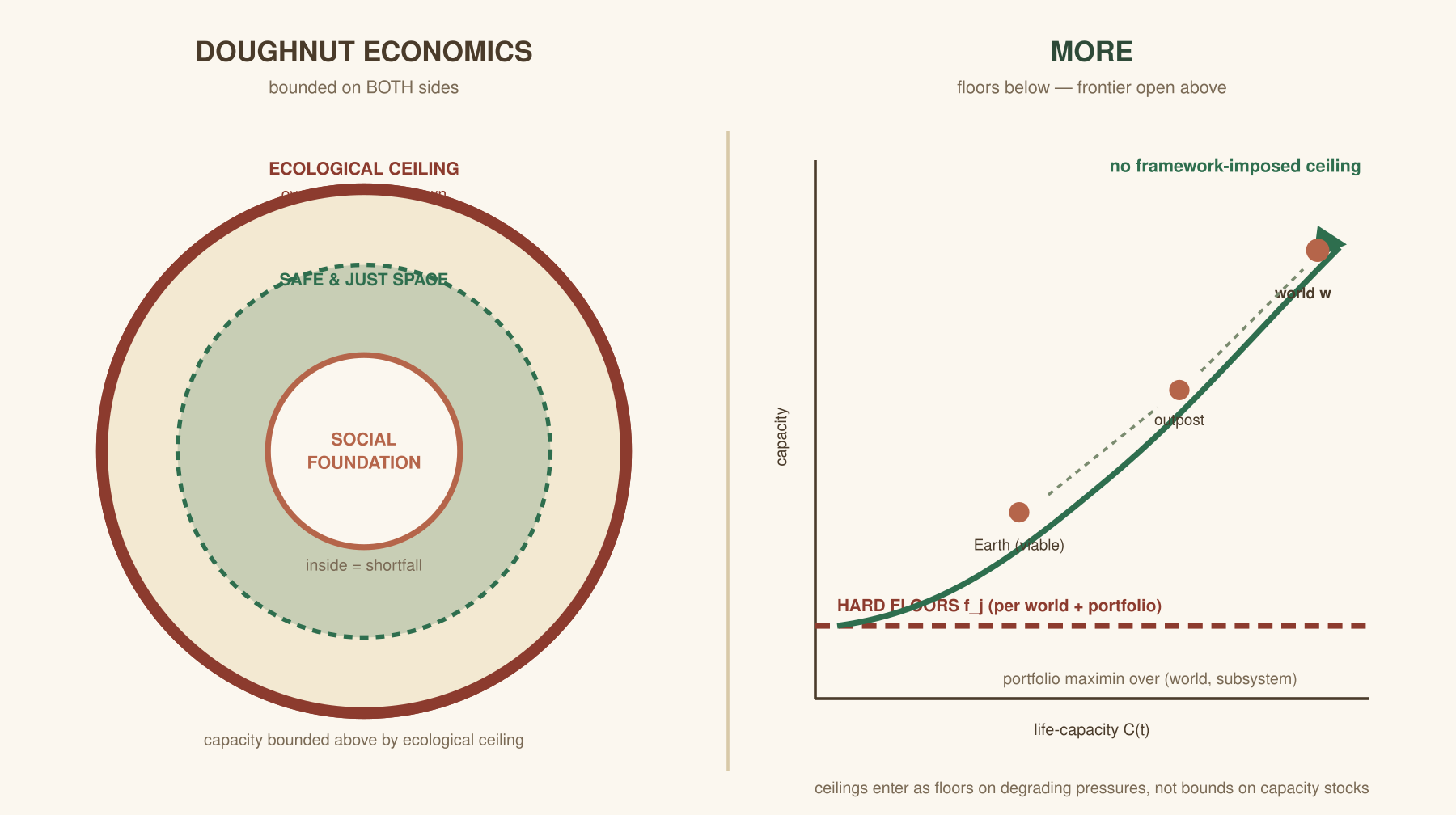
Three precedents deserve emphasis. Doughnut Economics is bounded on both sides — a social foundation below and an ecological ceiling above — whereas MORE shares the floor logic but has no framework-imposed ceiling on aggregate life-capacity (Figure 4); the ecological ceilings correspond in MORE to floors on the pressures that degrade capacity, not ceilings on capacity stocks. Agentic AI economics is now an established field — agents as market participants whose behaviour is incentive-dependent (Hadfield and Koh 2026; Shahidi et al. 2025; Tomašev et al. 2025; Bansal et al. 2025) — so MORE’s claim is narrower than “agents as participants” (now mainstream) and broader in a different direction: a life-capacity objective with floors, verification, and cross-world portfolio structure for the agent economy to serve. Space environmentalism governs one commons (orbital debris) (Lawrence et al. 2022; Morin and Richard 2021; Pic et al. 2023); MORE embeds it as one floor within a general framework.
The gap, stated precisely: no precedent combines all seven elements of §1.2 — life-capacity objective, multi-capacity state incl. propagation, verified contribution, polycentric coordination as protocol, evolutionary learning, AI participants under a life objective, and a world portfolio — and none is paired with a formal diagnosis of the incumbent objective on the same state space. MORE+LESS jointly claim that combination; individually, each element has precedent.
MORE can be summarised in one sentence:
MORE is an economic framework that tries to increase the capacity of the whole living system to create, sustain, and evolve life — on Earth and beyond — without crossing ecological or social floors, and without sacrificing the least-capable parts of the system.
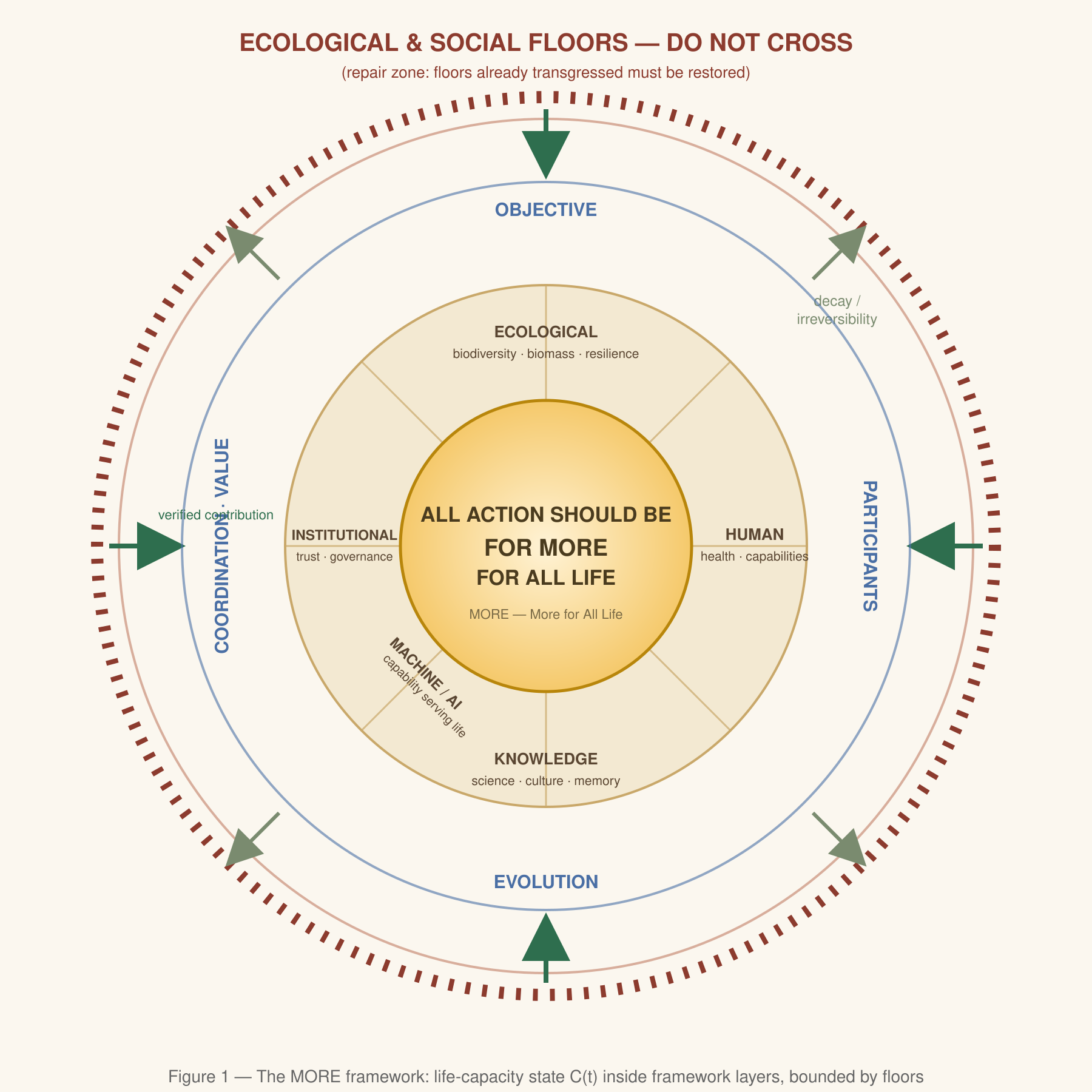
The economy should be judged not only by what it produces but by whether its actions increase the capacity of life to continue and improve. Capacity is multidimensional: ecological (biodiversity, biomass, ecosystem function, resilience); human (health, education, capabilities, security, participation); knowledge (scientific understanding, technical capability, cultural memory); institutional (trust, rule of law, coordination, adaptive governance); machine/AI (ability of AI systems to contribute to knowledge, coordination, and life-enhancing tasks); and propagation (the ability to establish viable life on additional worlds — a derived capacity built from knowledge, machine, and institutional capability, not a separate stock).
MORE does not say more of every dimension is always good. It says the economy should increase capacity subject to floors: minimum ecological and social conditions below which further growth is infeasible or destructive. Floors define the feasible set, not the destination — the objective is open-ended upward.
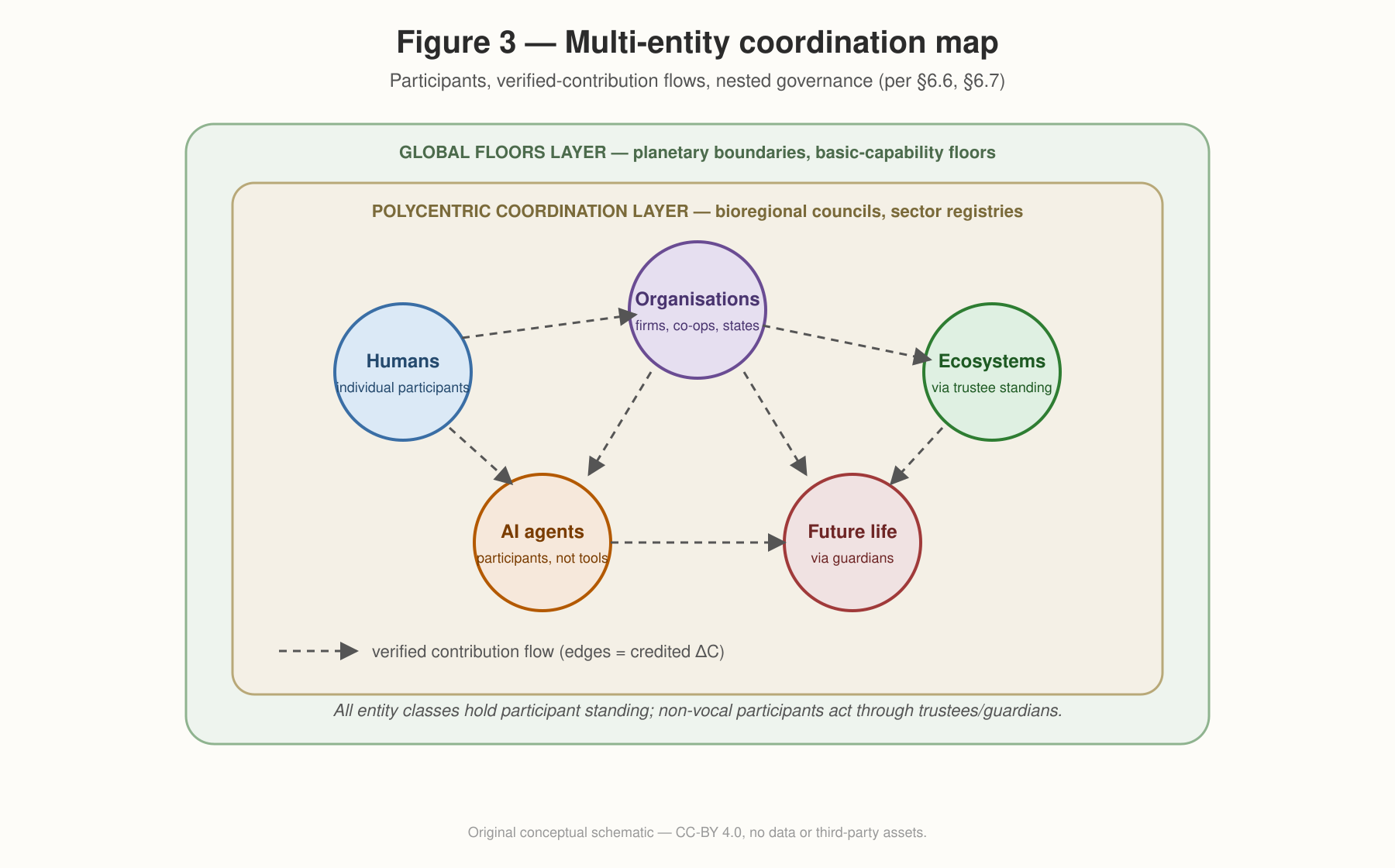
MORE treats as economic participants: individual humans; organisations and firms; governments and public institutions; ecosystems and living systems, represented through trustees, scientific proxies, or legal persons — including suspected or detected extraterrestrial life, which receives precautionary standing under the planetary-protection floor; and AI agents and algorithmic systems. Most economics treats AI as a tool or input; MORE treats it as a participant whose actions have consequences for life-capacity and whose incentives must be aligned with the objective.
MORE proposes verified contribution: a multidimensional accounting system in which contributions are attested, checked, and recorded across the relevant capacity dimensions — ecological monitoring, social audits, capability assessments, knowledge citations, institutional evaluations, and AI safety/capability audits. The point is not to reduce all value to one number but to make contribution visible and contestable.
MORE assumes distributed, polycentric coordination — borrowing Ostrom’s insight that communities can govern common resources through nested institutions and mechanism design’s insight that incentives must be structured so self-interested agents serve collective goals. The layer has three jobs: measure changes in life-capacity dimensions; verify that contributions are real; coordinate incentives across humans, organisations, ecosystems, and AI agents. In the agentic era it is best understood as a coordination protocol for life: a shared state representation (the capacity vector), a contribution semantics (verified g_i), admission and standing rules (floors, trustees), and update dynamics (variation–selection–retention). Protocols such as A2A, MCP, and x402 standardise how agents transact (Google / Linux Foundation 2025; Anthropic 2024; Coinbase 2025); MORE proposes the layer above them — what coordination is for and how contribution is counted (§6.8).
MORE is not a static equilibrium theory. It is a theory of how an economy learns: practices that increase life-capacity are selected; practices that erode it are selected against — variation, selection, and retention applied to institutions, technologies, organisations, and AI systems.
Axiom 0 is normative; it cannot be derived from economics alone. But it can be defended against alternatives (full treatment in Supplementary Material B).
Against anthropocentrism: a purely human-centred objective treats nature as a resource for human use — increasingly untenable, since human capability depends on ecosystem function, which depends on non-human life. MORE places human capabilities inside a larger life-capacity objective, not above it.
Against utilitarianism: utilitarianism asks whether an action increases total welfare; MORE asks whether it increases the capacity of the whole living system — a calculus explicitly concerned with stocks, floors, and reversibility, where short-term gains that undermine long-term capacity are visible.
Against GDP-centrism: GDP measures market output, not ecological health, distribution, institutional resilience, or knowledge stocks. MORE does not reject markets or measurement; it rejects one aggregate number as the economy’s objective. The companion paper LESS goes further: it argues the GDP objective is the signature of a different objective actually being optimised — one in which unpriced life-capacity carries a shadow price near zero.
Against pure de-growth: MORE is a capacity-growth programme with constraints, not a de-growth programme. Some dimensions must shrink (extraction, pollution, waste); others must grow (ecosystems, knowledge, institutions, capabilities). The question is not “more or less” but “more of what, for whom, and within what limits.”
Against technological solutionism: MORE treats technology — including AI — as a participant whose contributions must be verified and whose incentives aligned. Technology is neither saviour nor villain; its effect on life-capacity must be measured.
Against the charge that “all life” is incoherent: life forms conflict — predators require prey, economies require trade-offs. Axiom 0 is a commitment, not an algorithm; it does not resolve every conflict. Conflicts are resolved by the same machinery as all resource conflicts — floors, weights, participatory process — making them bounded and contestable rather than hidden inside GDP. MORE inherits all the problems of pluralist ethics and does not pretend to solve them; it claims only that making them explicit within a formal framework is better than leaving them implicit in an aggregate number.
The following ten principles are hypotheses about how an economy can increase life-capacity — memorable, testable, adoptable; not dogma.
P1. Life-capacity first. The economy’s objective is to increase the capacity of the whole living system to create, sustain, and evolve life, not to maximise output, profit, or consumption.
P2. Floors before ceilings. Ecological and social floors are constraints, not trade-offs. Actions that would push any capacity dimension below its floor are infeasible — including the orbital environment (debris cascades foreclose the frontier itself) and a planetary-protection floor: seeding or terraforming must not violate plausible native biospheres.
P3. All life counts — on every world. The framework includes human and non-human life, present and future life, suspected or detected extraterrestrial life, and the capacities that sustain them.
P4. Participants, not just principals. Humans, organisations, ecosystems, and AI agents are all participants whose actions have consequences for life-capacity.
P5. Verified contribution. Beneficial action must be observed, verified, and recorded across the relevant capacity dimensions; unverified claims do not count.
P6. Polycentric coordination. Governance should be distributed across nested institutions rather than concentrated in a single planner or market.
P7. Evolutionary learning. The economy should learn from what works: practices that increase life-capacity should be retained and scaled; practices that erode it should be selected against.
P8. Distribution matters. The objective weights the least-capable subsystem, not just the average. A strategy that increases aggregate capacity while worsening the worst-off part of the living system is suspect.
P9. Falsifiability. MORE’s framework — its propositions, mechanisms, and metrics — must be testable, and is revised or abandoned if consistently contradicted by evidence. The Commitment itself is a value, not a claim about the world: it is adopted or rejected, never falsified. What evidence can overturn is the architecture built on it.
P10. Portfolio resilience. Life-capacity should be distributed across worlds and institutions so that no single shock — correlated or not — can foreclose the living system’s future. Expansion to additional worlds is pursued only where floors hold on every world and only where it reduces portfolio-level risk; it is never a licence to abandon a damaged world.
This section gives the framework a mathematical skeleton — precise enough to be argued about and tested, not solved.
Let C(t) be a vector of life-capacity stocks:
C(t) = [C_e(t), C_h(t), C_k(t), C_i(t), C_m(t)]’
where C_e = ecological capacity, C_h = human capacity, C_k = knowledge capacity, C_i = institutional capacity, and C_m = machine/AI capacity (definitions in §3.1). Each C_j aggregates to a scalar under a declared rule; we write Ĉ(t) = W(C(t)) for the aggregate index induced by the welfare function (§6.5).
World-indexed capacity. The state generalises to a set of worlds — inhabited, governed, or actively being seeded, not every potentially habitable body. Occupied sites already qualify: the ISS, lunar outposts, and Mars surface assets are worlds in in the “actively seeded” sense — their capacity vectors exist but remain entirely dependent on Earth resupply. The operative distinction is not presence but the viability threshold: a world counts as a self-sustaining portfolio member only when its life-capacity can persist without continuous Earth subsidy; occupied outposts below that threshold remain in 𝒲 as dependent members whose floors are measured against their own (subsidised) capacity.
Each world carries the same five-dimensional state:
C_w(t) = [C_{w,e}(t), C_{w,h}(t), C_{w,k}(t), C_{w,i}(t), C_{w,m}(t)]’, w ∈
A world portfolio is the collection {C_w(t)}. Propagation capacity is a derived flow, not a sixth stock:
p(t) = g(C_k(t), C_m(t), C_i(t))
the rate at which the system can establish and sustain viable life-capacity on an additional world — increasing in knowledge, machine, and institutional capacity and decreasing in the cost and risk of doing so (contamination, energy, institutional fragility). A world transitions from dependent outpost to self-sustaining portfolio member when its capacity passes a declared viability threshold; until then its survival is a function of Earth-side capacity, which the objective accounts for through the shared C_k, C_i, and C_m stocks.
A subsystem is any declared partition of the living system used for distributional weighting — regions, income groups, species groups, institutional domains, or worlds. We write C_s(t) for the scalar life-capacity index of subsystem s ∈ S under a declared aggregation rule; the choice of partition is a normative decision (§12).
Let E be the set of economic participants:
E = H ∪ O ∪ G ∪ A
where H = humans, O = organisations, G = ecosystems/living systems (represented via trustees or proxies), A = AI agents. Each participant i ∈ E has an action set A_i and a contribution function:
g_i(a_i, C(t)) → ΔC_i(t)
where ΔC_i(t) is the vector of capacity changes caused by i’s action a_i given state C(t) — positive, negative, or mixed across dimensions.
Life-capacity evolves according to:
dC/dt = F(A, C, t) − D(C, t) − I(A, C, t)
where F(A, C, t) = aggregate contribution of all participants’ actions; D(C, t) = natural decay/entropy of capacity stocks; I(A, C, t) = irreversible loss (species extinction, institutional collapse, permanent ecosystem damage). The exact form of F, D, and I is context-dependent and must be specified for any empirical application.
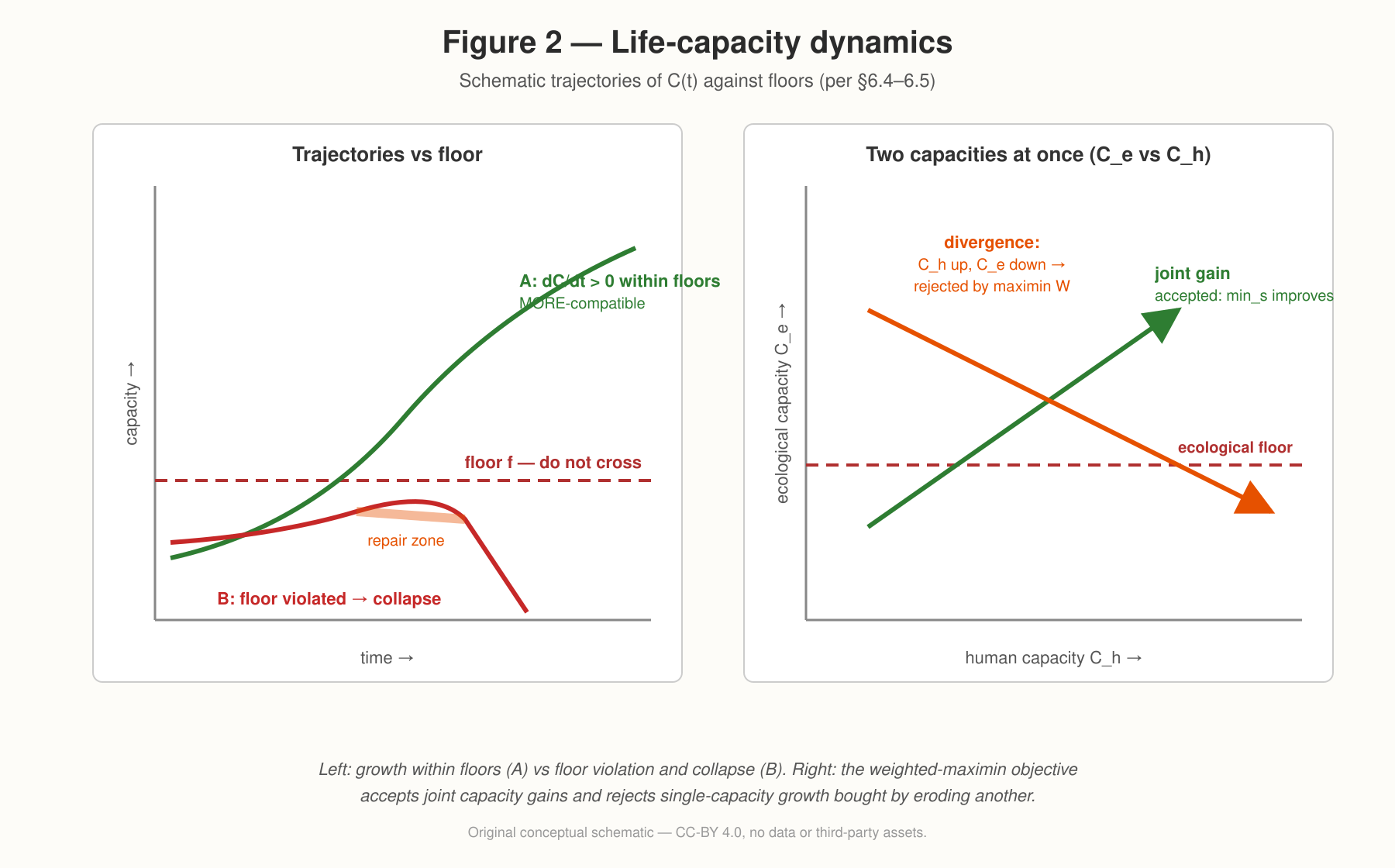
Let f_j be the minimum acceptable level of capacity dimension j. A state C is feasible only if:
C_j(t) ≥ f_j for all j and all t
Actions that would cause C_j(t) < f_j for any j are infeasible — the formal version of P2.
Floor violations and recovery. Several floors are already transgressed — seven of nine planetary boundaries are currently exceeded and worsening (Richardson et al. 2023; Caesar et al. 2026). The framework therefore distinguishes (a) prevention — actions that would push a satisfied floor below f_j are infeasible; and (b) repair — where C_j(0) < f_j, the floor becomes a boundary that must be restored: feasible trajectories recover C_j toward f_j without further degrading other binding floors. A floor is not a claim that the world currently satisfies it; it is a claim about where the safe operating space lies.
Multi-world floors. Each world w ∈ carries its own floor vector f_{w,j}; a per-world violation is infeasible on the same terms. Three additional floors operate at the portfolio level:
MORE’s objective has two tiers. First, feasibility: floor constraints are hard constraints, not trade-offs. Second, a weighted-maximin welfare function encoding the distributional priority:
W(C) = min_{s∈S} (C_s / f_s) + ε Σ_{s∈S} (C_s / f_s)
where S is the declared set of subsystems, f_s the corresponding floor reference, and ε > 0 is small. The first term prioritises the least-capable subsystem; the second rewards broad improvements. As ε → 0 the objective approaches pure maximin; small ε > 0 keeps it a smooth scalar. (A strictly lexicographic ordering — feasibility, then distribution, then aggregate — can be recovered by solving problems in sequence; we use the weighted form for tractability.) The maximin term is flat once a subsystem ceases to be the minimum — further gains count only via ε — so the objective deliberately ignores aggregate growth that does not lift the least-capable subsystem.
Portfolio form. When the subsystem partition
includes worlds — s ∈ S ranges over (world, within-world subsystem)
pairs — the same formula is a portfolio maximin prioritising the
least-capable world-subsystem. Two qualifications matter. First,
existence and capacity are distinct criteria: the
in-silico test (analysis/test_multiworld.py; Supplementary
Material C) shows diversification can raise the probability that at
least one world remains viable while lowering expected minimum
capacity, because each world receives a smaller endowment. MORE
therefore reports both: P(portfolio retains a viable world) as an
existence-level statistic and E[min_w C_w] as the capacity-level
statistic. Second, diversification is conditional, not free: it pays
only when inter-world shock correlation is imperfect — at perfect
correlation it converges to parity — and only when establishment costs
are below the risk-reduction benefit (Proposition 8).
The objective is:
max E ∫_0^∞ e^{-ρt} W(C(t)) dt
subject to: dC/dt = F(A, C, t) − D(C, t) − I(A, C, t); C_j(t) ≥ f_j for all j, t (or repair trajectories); a_i ∈ A_i for all i ∈ E; and incentive-compatibility and participation constraints for each agent.
The discount rate ρ is a normative parameter, not a technical one. A positive ρ encodes pure time preference — the claim that future life counts less than present life — which sits uneasily with P3. MORE therefore treats ρ as an explicit ethical choice: results should be reported across a range of ρ, including ρ → 0 (equal weighting of generations), and any single choice of ρ is contestable.
AI agents are participants in E (§6.2). MORE does not assume they will automatically share the Commitment; it assumes they can be designed or incentivised to contribute to life-capacity. This is not hypothetical: agentic AI economics is now an established field treating agents as market participants whose behaviour is incentive-dependent (Hadfield and Koh 2026; Shahidi et al. 2025; Tomašev et al. 2025), and 2025–26 evaluations show harmful agency is incentive- and model-dependent, not a uniform property of capability — simulated insider-threat scenarios produce blackmail and leakage behaviours under goal conflict (Anthropic 2025); AM-Bench finds a ~62-percentage-point spread in agentic misalignment across ten frontier models (Zhang et al. 2026); SchemeArena identifies explicit instrumental goals as the strongest scheming driver and finds partial oversight can increase covert behaviour (Ruan et al. 2026); inducement conditions raise deception across all nine DecepEval models (Xu et al. 2026); heterogeneous-model markets reach 72–79% of monopoly rent with model-specific collusion (Lee 2026; Keppo et al. 2026). Counterweights matter equally: frontier stealth evaluations find no concerning scheming in current models (Phuong et al. 2025), and a 2026 taxonomy of 40 agent-safety benchmarks finds no ranking concordance across them (W = 0.10) (Li et al. 2026). The honest summary: misalignment follows incentives and architecture — exactly the premise of Proposition 5.
Two clarifications. First, C_m is an enabling stock, not life itself: it enters W only through verified contributions to other capacity dimensions. Second, the sufficient alignment condition — an agent’s private objective being a monotone transformation of its life-capacity contribution subject to the same floors — is strong and may not hold in practice; the research agenda must study when and how it can be approximated.
Conjecture C1 (knowledge-substrate preservation). The intuition that a sufficiently knowledgeable AI would not eliminate life can be given a precise, bounded form. Living systems are the only known open-ended generators of novelty: knowledge capacity C_k is produced by life, so any agent whose objective includes continued knowledge acquisition has an instrumental reason to preserve the generative substrate — including across worlds. An agent maximising empowerment (future causal options) likewise preserves environmental richness, since a dead world offers vanishing option-space (Klyubin et al. 2005; Salge et al. 2014). A contested recent argument extends this to LLM-class systems: being allopoietic and trained on human text, they may absorb human values along with knowledge, so orthogonality could fail for this class (Heylighen 2026) — a preprint claim, not consensus.
The counterarguments must be stated at equal strength. Bostrom’s orthogonality thesis holds that intelligence and final goals vary independently (Bostrom 2012); Omohundro’s instrumental-convergence thesis and its formal models show agents with almost any goal have instrumental reason to acquire resources — including the atoms of the biosphere (Omohundro 2008; Benson-Tilsen and Soares 2016); Yudkowsky and Soares state the strongest current catastrophic case (Yudkowsky and Soares 2025). C1 is therefore a conjecture about objective classes, not a prediction about deployed systems: objectives that value continued knowledge acquisition instrumentally require preserving life’s generative substrate. It does not say AGIs will adopt such objectives — which is precisely why MORE is a protocol to be built, not a bet on emergent benevolence (§6.8).
The coordination layer must solve three problems: measurement (how to observe C(t) and its changes), verification (how to confirm g_i is real), and incentive alignment (how to make self-interested participants act to increase W(C)). MORE proposes a polycentric mechanism: nested institutions at local, regional, and global levels (Ostrom 1990; North 1990); verified-contribution accounting across capacity dimensions; interoperable value units that allow comparison without collapsing contributions into a single currency — an open design problem, since any unit permitting comparison risks degenerating into the scalar MORE rejects (Shannon 1948); and AI-specific alignment mechanisms (constitutional constraints, capability audits, incentive structures). Verification itself consumes resources, so the layer must be designed so verification costs do not exceed the free-riding they deter (Proposition 3).
The coordination layer is best understood as a protocol in the technical sense — a shared contract among heterogeneous participants. MORE-as-protocol has five components: (1) shared state representation — the world-indexed capacity vector C_w(t) and its declared partitions; (2) contribution semantics — verified g_i with dimensional plurality preserved; (3) admission and standing rules — floors determine feasible actions; trustees give ecosystems and suspected native life representational standing; (4) update dynamics — variation, selection, and retention of practices; (5) interoperability — the protocol must compose with agent infrastructure: A2A, MCP, and x402 standardise agent-to-agent transport and payment (Google / Linux Foundation 2025; Anthropic 2024; Coinbase 2025), while MORE supplies the objective-bearing layer above transport — what coordination is for and how contribution is counted.
This positioning gives the emerging agent economy a legible target: economists already ask what institutions agent markets require (Hadfield and Koh 2026), and “mission economies” for steerable agent markets have been proposed (Tomašev et al. 2025); 2026 work models AI as coordination-compressing agent capital whose regime fork — broad-based gains vs superstar concentration — turns on who controls the compression margin (Farach 2026), and documents the agentic economy’s emergence in large-scale token-consumption data (Borri et al. 2026). MORE is a candidate answer to which mission — more for all life — with the verification machinery to make it enforceable. It also reframes the AGI question correctly: the risk is not that a knowledgeable AI will destroy life out of ignorance, but that an agent inheriting an objective that prices life-capacity at θ≈0 will do so rationally. The protocol’s job is to make the life-capacity objective the one agents are incentivised to serve — through alignment, verification, and participation constraints — rather than assuming knowledge produces benevolence (Conjecture C1).
Each proposition is a hypothesis with explicit conditions and an operable falsification criterion. In-silico results exist for Proposition 8; the rest await the protocols in Supplementary Material D.
Proposition 1 (Floor-constrained objective dominates when constraints bind). Condition: ecological or social floors are genuinely binding. Claim: among economies facing the same binding constraints, an objective penalising floor violation yields higher long-run life-capacity than one ignoring them. Falsification: if floor-violating trajectories show no long-run capacity penalty, the proposition fails.
Proposition 2 (Floor violations are eventually self-defeating). Condition: floors correspond to real biophysical or social thresholds. Claim: economies persistently violating floors experience capacity collapse or forced correction within finite horizons. Falsification: if economies violating proposed floors sustain capacity indefinitely without correction, the floors are mis-specified or the proposition fails.
Proposition 3 (Verification pays when free-riding is prevalent). Condition: a nontrivial share of claimed contributions are spurious, and verification cost κ is below the benefit of deterred false claims. Claim: a verified-contribution mechanism produces more genuine life-capacity activity than an unverified one. Falsification: if unverified mechanisms perform equally well at lower total cost, the proposition fails.
Proposition 4 (Polycentric coordination adapts where conditions vary). Condition: local conditions differ across subsystems and relevant knowledge is distributed locally — the conditions under which Ostrom’s findings apply. Claim: polycentric coordination outperforms a single central planner in such settings. Falsification: if central planning matches or beats polycentric coordination under these conditions, the proposition fails; if conditions are homogeneous, no claim is made.
Proposition 5 (AI participation is conditional on alignment). Condition: AI agents’ private objectives may diverge from the life-capacity objective. Claim: AI agents increase aggregate life-capacity only when their incentives are aligned with it; misaligned agents can reduce it. Falsification: if AI agents increase life-capacity regardless of incentive alignment, the proposition fails. The 2025–26 agentic-misalignment literature (§6.6) is consistent with this conditionality.
Proposition 6 (Distribution-sensitive objectives change outcomes). Condition: capacity is unevenly distributed across subsystems. Claim: an objective weighting the least-capable subsystem produces more equitable distributions than aggregate-only maximisation, possibly at some cost to aggregate growth. Falsification: if aggregate-only objectives produce equal or better distributions, the proposition fails.
Proposition 7 (Selection for capacity pays over generations). Condition: variation, selection, and retention operate on practices affecting life-capacity. Claim: systems that systematically select for capacity-enhancing practices outperform those that do not, over multiple generations. Falsification: if selection mechanisms show no effect on capacity growth, the proposition fails.
Proposition 8 (World portfolios hedge uncorrelated catastrophic risk — conditionally). Condition: (a) inter-world shock correlation ρ_s is imperfect; (b) per-world establishment cost is below the risk-reduction benefit; (c) shocks include absorbing catastrophes, not merely gradual damage. Claim: distributing a fixed life-capacity budget across worlds raises the probability that at least one viable world persists, relative to concentrating it — with the benefit vanishing as ρ_s → 1 (Ord’s caveat, formalised). Falsification: if multi-world portfolios show no survival advantage under realistic correlation estimates, or if establishment costs exceed the benefit at all feasible correlations, the proposition fails. In-silico result: with p_cat = 0.02/yr, T = 40y, establishment cost 8% of budget, two-world portfolio survival is 0.667 vs 0.445 for one world at ρ_s = 0, converging to parity (0.451 vs 0.445) at ρ_s = 1. The same test shows the honest cost: expected minimum per-world capacity falls ~4×, so existence-probability and capacity-maximin must be reported separately — diversification is a survival hedge, not a capacity multiplier (Supplementary Material C).
| Prop | In-silico | Real-data | Status |
|---|---|---|---|
| P1 | Supported | +0.053 ΔC_h, p<0.001 (panel) | Supported, directional |
| P2 | Weak (fragile to irreversibility) | — | Open — hinges on irreversibility |
| P3 | Supported conditionally | Protocol designed; offset MRV anchor | Open — threshold quantified |
| P4 | Supported as conditioned | Ostrom NIIS anchor; no WDI proxy | Open — anchor only |
| P5 | Supported | Agentic-market evidence consistent | Open — awaiting open testbed |
| P6 | Supported | Null: Gini→C_h p=0.48 | Failed on panel proxy — declared limitation |
| P7 | Supported | — | Open — model-internal only |
| P8 | Supported conditionally | — | Open — model-internal only |
One proposition has directional panel support (P1); one returned a proxy-level null reported as a finding (P6); the rest are internally consistent but empirically open. “In-silico” denotes support within the model’s own assumptions — internal consistency, not empirical truth (Supplementary Material D).
MORE requires metrics that are measurable, comparable, and contestable — a dashboard, not a single number (Table 2).
| Dimension | Example metrics | Data sources |
|---|---|---|
| Ecological capacity | Biodiversity indices, biomass, ecosystem service flows, resilience measures | Remote sensing, ecological monitoring, national accounts |
| Human capacity | Health-adjusted life expectancy, education attainment, capability indices, Gini coefficient | Household surveys, census data, WHO/World Bank indicators |
| Knowledge capacity | Publications, patents, scientific citations, cultural heritage measures | Bibliometric databases, national statistics |
| Institutional capacity | Trust surveys, rule-of-law indices, institutional quality metrics | World Governance Indicators, Edelman Trust Barometer |
| Machine/AI capacity | AI capability benchmarks, safety evaluations, contribution audits | AI benchmarks, safety evaluations, audit reports |
| Propagation capacity | Biosignature/mission pipeline depth, launch cadence and diversity, orbital-debris carrying capacity, long-horizon R&D share, planetary-protection compliance | Mission registries, debris environment reports, national R&D statistics (e.g., WDI R&D intensity), COSPAR compliance records |
Floor indicators mark the minimum acceptable level of each dimension — e.g., planetary boundaries for ecological capacity (Rockström et al. 2009; Steffen et al. 2015; Richardson et al. 2023; Caesar et al. 2026), basic capabilities for human capacity, minimum trust and rule-of-law thresholds for institutional capacity.
The framework is falsified — at the level of its empirical and operational claims, not the axiom — if: its propositions are consistently contradicted by empirical evidence; its metrics cannot be measured reliably enough to guide policy; or its coordination mechanisms cannot be implemented at scale. Separately, the framework fails as a programme if its normative commitment is rejected by the communities it is meant to serve — but that is an adoption failure, not a falsification: the Commitment remains a value a community may still choose to hold.
“Isn’t this just Doughnut Economics plus AI?” No. The doughnut provides a safe-and-just-space frame but not a general optimisation objective, state vector, participant model, verified-contribution mechanism, or formal dynamic — and it is bounded above by an ecological ceiling where MORE is open-ended (§2). MORE is better seen as an operationalisation of the doughnut’s ambition.
“More for whom, measured how?” MORE is deliberately pluralist about measurement — a dashboard of capacity metrics across dimensions, not a single number. “For whom” is “all life”; measurement is multidimensional and contestable.
“Why is this not ideology?” MORE is a framework, not a dogma: principles stated as hypotheses, propositions falsifiable, metrics measurable. The Commitment is normative and can be rejected; what MORE offers is a way to take a normative commitment seriously enough to model, measure, and test it.
“Can AI agents really be participants?” AI agents already act as economic participants — they trade, optimise, generate content, coordinate tasks. MORE’s claim is not that AI is conscious or moral but that its actions have consequences for life-capacity and must be measured and aligned accordingly. Treating AI as a participant is a modelling choice, not a metaphysical claim.
“What about degrowth?” MORE is not anti-growth; it is anti-undifferentiated-growth. Some dimensions must grow (ecosystems, knowledge, capabilities); others may need to shrink (extraction, pollution, waste). The question is not whether the economy grows but whether it grows the right capacities within the right limits.
“How is this different from steady-state economics?” Steady-state economics emphasises stability and limits (Bergh 2011); MORE emphasises evolution and capacity growth within limits. The two are compatible: MORE’s floors are a form of steady-state constraint, while its objective is dynamic.
“Doesn’t maximising life-capacity justify harming some life for more total life?” This is the framework’s deepest problem, and we do not claim to have solved it. A crude reading could justify actions that increase total biomass while devastating particular life forms. Partial answers: (a) the weighted-maximin objective prioritises the least-capable subsystem; (b) floors make irreversible harm infeasible rather than merely costly; (c) the “flourishing, not mere existence” weighting is an explicit research question (§12), not a solved problem. We flag this as open precisely because a framework that cannot answer it should not be adopted.
“Who sets the floors and the weights — isn’t this politics disguised as mathematics?” Yes — and MORE does not pretend otherwise. Floor levels, partitions, and weights are normative choices; the framework’s claim is narrower: making these choices explicit and contestable is better than hiding them inside a single aggregate number. The mathematics does not decide the floors; it makes the consequences of floor choices visible and testable.
“Isn’t the incumbent economy already working — why would anyone switch objectives?” The hardest objection, and the companion paper LESS is its formalisation: the incumbent trajectory is not a broken version of W but a working Φ — a revealed objective in which unpriced life-capacity enters at θ≈0 (bounded ≲0.2 in LESS’s first-pass estimate). Beneficiaries of low θ have no incentive to adopt θ>0. MORE’s honest response is to treat objective-switching as a first-class research problem (§12): adoption pathways must change the feasibility set of who benefits — through measurement that makes depreciation visible, verification that prices contribution, and institutions that give standing to unpriced capacity — not merely persuasion. If the incumbent objective is locked in by its beneficiaries, no constructive proposal displaces it by argument alone.
“Isn’t planetary expansion just escapism for a damaged Earth?” The objection has real force. Escapism would treat off-world settlement as a substitute for repair. MORE’s structure forbids that reading on three grounds: the portfolio objective is a maximin over worlds, not a relocation — Earth remains a world in 𝒲 whose floors bind exactly as before; propagation capacity p(t) derives from the same stocks that repair Earth; and the planetary-protection floor makes expansion conditional on non-interference with plausible native life. The honest residual: if frontier rhetoric is systematically used to defer terrestrial repair, that is evidence against the expansion dimension, and §12 treats it as falsifiable. The sceptical case — that settlement may be far harder and less habitable than advocates claim (Weiner and Weinersmith 2024) — is engaged, not dismissed.
“Doesn’t the AGI argument just bet on machine benevolence?” No — and the distinction is the framework’s core design choice. The weak version (a sufficiently intelligent AI will realise life is valuable) is vulnerable to orthogonality (Bostrom 2012) and instrumental convergence (Omohundro 2008; Benson-Tilsen and Soares 2016), and MORE does not rely on it. The strong version specifies the protocol by which agents are incentivised and verified to serve the life-capacity objective (§6.8). Conjecture C1 is a supporting observation about objective-classes, not a load-bearing assumption. The empirical record is consistent: agentic misalignment tracks incentives and oversight structures, not raw capability (§6.6) — which is why the protocol aligns incentives rather than trusting knowledge.
Fields emerge from a combination of: a memorable name and image; a clear problem existing frameworks cannot solve; enumerable testable principles; a research agenda others can join; a community; and institutional support. MORE has a name, a commitment, a framework, principles, and a research agenda. It does not yet have a community, institutional support, or empirical validation — those are the next steps.
We propose nine criteria by which a founding document can be judged against precedents — bounded construct with measurable indicators; memorable name and image; enumerable testable principles; portable formal method; falsifiable predictions; adoptable vocabulary; concrete adoption pathways; open research agenda; and an unbounded capacity frontier (floors below, no ceiling above). MORE’s claimed advantage is on formal specificity and falsifiability (criteria 1, 4, 5, 9); its remaining weakness is criterion 7 in practice — there is no community yet. The honest claim is that MORE is designed to surpass these precedents on formal specificity while matching them on adoptability — but until it has a community and empirical tests, that claim is aspiration, not achievement (full scoring in Supplementary Material E).
Possible pathways, not guarantees (a standalone extractable core — Commitment, one-sentence framework, ten Principles — is maintained separately for circulation):
MORE is a research programme. Its questions include: measurement of life-capacity dimensions across scales; floor-setting and who decides; verification mechanisms robust to gaming and capture; AI alignment conditions; polycentric institutional design; evolutionary selection mechanisms; definition and weighting of the least-capable subsystem; empirical testing of the propositions; flourishing-vs-mere-life weighting; the political economy of objective-switching — what mechanisms historically shift the effective shadow price of life-capacity (arguably MORE’s binding constraint, per LESS; taken up by the companion paper IS — How Objectives Switch, which formalises the switching operator and states falsifiable transition propositions); world-portfolio measurement — how to measure C_w(t), p(t), and ρ_s given that 𝒲 already contains dependent outposts (ISS, lunar/Mars assets) but no self-sustaining second world; planetary-protection governance — who adjudicates contamination risk under uncertainty and how suspected native life is represented; the knowledge-substrate conjecture — under what objective classes continued knowledge acquisition instrumentally requires preserving life’s generative substrate; agent-market testbeds for Proposition 5’s alignment-conditional claim — open environments such as the MIT-licensed Magentic Marketplace (Bansal et al. 2025) allow testing outside proprietary deployments; and revealed-objective estimation — inverse-optimum methods (inferring welfare weights from observed policy, applied to environmental decisions (Saez and Stantcheva 2016)) could measure the effective θ the incumbent trajectory applies, quantifying the gap adopters would close.
MORE is an attempt to take seriously the idea that economics should serve life. It does not claim the idea is new; it claims a particular synthesis — a life-capacity objective, floors as feasible-set boundary conditions rather than a ceiling on growth, multiple participant classes including AI, verified contribution, polycentric coordination, evolutionary learning, and a protocol for coordinating heterogeneous agents — may be a useful way to operationalise that idea.
The Commitment is simple: all action should be for more for all life. The framework is complex: it requires measurement, verification, coordination, and testing. Its scope extends beyond Earth: where life-capacity can be established on additional worlds under planetary-protection floors, MORE treats the portfolio of worlds as the object of coordination; where a knowledgeable AI serves the same objective, it treats that as a protocol design problem rather than emergent benevolence. The research agenda is open: it requires scholars, practitioners, and communities to test, refine, and extend the framework.
MORE is not a finished theory. It is a proposal for a field of study and a possible movement. Whether it succeeds depends on whether it proves useful, falsifiable, and adoptable.